Sunday, June 26, 2011

Writing.

Writing. Writing. Writing. 

I don't really want to stop writing because thing words are flowing, but I need to get back into the habit of blogging regularly. So here's a compromise: a short story. Enjoy!


Daddy’s Girl


“Daddy!”


Nature endowed adolescent girls the ability to produce a vocal tone calculated to turn the spinal cord of any adult in hearing range into a substance with the density and consistency of Jell-O, thus rendering the adult helpless while scoring the youngster her heart’s desire, fleeting though that desire might be. Monica Wellstonecraft had perfected that nasal, whiney timbre and was currently deploying it against her father.


“Daaad-dee-ee!” 


Although Monica had not entered her father’s workroom, he knew that tone all too well. Monica, it would seem, was not happy. Although Tyrone the Malevolent was recently named “Wizard to Watch” in Evil Magic Weekly, his daughter seemed oblivious to his growing status in the magical world. To her, Tyrone the Malevolent was merely “Daddy: Granter of Wishes, Dispenser of Cash.” 


The mage closed his eyes and sighed against the disruption. “What is it, Princess?”


“Daddy! Why do you hate me so?” 


Tyrone gritted his teeth and muttered a quiet curse, which he immediately regretted as the pot containing a sprout of vena rutilus vertebrae effractum exploded, scattering shards of pottery and clods of dirt all over the lab, and in the process, releasing one particularly vicious shoot of foliage. With a lazy wave of his wand, the pot mended itself and dirt swept itself into the mended pot. The Red Veined Spine Snapper, however, climbed up the wall and fled through the open window, hell-bent on world domination.


Making note of the escaping flora, the wizard felt a certain obligation to retrieve and contain said Snapper; however, he was too preoccupied with more pressing matters. Specifically, the whims of an unhappy twelve-year-old child.


 At that precise moment, the door to his workroom banged open and the object of his consternation burst into the laboratory. 


Most of the world saw Monica Alexis Nichole Wellstonecraft as an exceptional child, one with the delicate bone structure of a fairy, the grace of a ballerina, and the countenance of an angel. Pale with striking violet eyes, pink Cupid lips, and gently curling shoulder-length raven hair, Monica was the storybook picture of sweetness and innocence, with the promise of poise and confidence blooming just below the surface.


To those who knew her, however, Monica was as delicate as a tank, with the voice of a banshee and the demeanor of hungry tiger. A very angry hungry tiger with an excessively nasty attitude. When her temper got the better of her, Monica showed some of the rough edges that were supposedly being smoothed out at Miss Falconi’s School for Girls, one of the finest finishing schools in all the land. Currently, the normally self-possessed and precocious young lady seemed completely possessed by a disagreeable, dark humor. 


Screwing up her face into a most unattractive expression, Monica unleashed a screeching accusation at her father. “Drusilla Cuthburt’s daddy loves her more than you love me!” Before her father could respond, Monica continued her tirade. “And Livia McCartle’s daddy loves her more than you love me! And Felicity Phelps and Sinead Price and Evan Sainte-Cloud. Even that fat cow Courtney Stuart’s father loves her more than you love me!”


Completely exasperated, Tyrone removed the cauldron from the flame and turned off the Bunsen burner. It was obvious that he would not complete his award-winning special blend of Mind-Control Potion anytime soon. At times like these, he regretted having turned Monica’s mother into a newt. 


Today, he almost envied her, the amphibious life suddenly having taken on tremendous appeal.


Gritting his teeth, Tyrone pulled his mouth into something resembling a smile and, turning to face his daughter, asked, “Pumpkin, whatever do you mean? Of course I love you, Precious.”


“Then why don’t you show it?” Monica demanded, stamping her foot for emphasis.


Tyrone’s right eyelid fluttered rapidly, although not from any conscious effort. Medically, this flutter would be referred to as a spasm, or possibly a tic, an involuntary reaction to the foot-stamping. Drawing in a steadying breath, Tyrone took a moment to center himself before he began to speak. “Why, Angel, I believe I do show you how much I love you. Every day.”


His mouth had very nearly said, The fact that you’re still here rather than sunning yourself on a rock is a sign of my utter devotion. But his brain quelled his mutinous tongue before the words could burst forth.


“You don’t love me. If you loved me, you’d buy me a minion!”


Ah. That’s what this little display is about, thought Tyrone. Minions. 


“Pudding, we’ve discussed this. You are too young for a minion.”


“But everybody else has a minion! I’m the only girl at school without one!” Her mouth, if possible, curled into an even more pathetic pout and her eyes managed to squeeze out some moisture that could have been tears. 

“I want a minion!”


“Lumpkins, you don’t need a minion. Why do you want a minion, anyway?”


Monica sniffed twice, then swallowed hard in an obvious attempt to control her faux tears. “Oh, Daddy,” the torrent began. “Minions are the best. They just are. Everyone has one. They bring them to class and the minions wreak havoc with the lessons and even though the teachers have registered a formal complaint, Headmistress Falconi said that minions can be a tool for learning and that we are permitted to bring them and, oh, Daddy, don’t you see why I need a minion? It’s a matter of education.” 

On that note, Monica widened her violet eyes in anticipation, then batted her lengthy black lashes at her father. This simple “smile and flutter” tactic had worked on numerous occasions in the past, and there was no reason to believe it wouldn’t work now. 


For a long, quiet moment, Tyrone the Malevolent stared at his daughter, too dumbfounded to speak. Monica said that owning an evil minion would further her education. While he was certain that was true on some levels, his Father Instinct told him that he was being played. 


Yet, he couldn’t resist the powerful pull of a spirited, well-articulated debate. The air was heavy with the promise of logic, reason, and argumentation based on sound principles. A debate such as this one would give him a chance to put her skills in the rhetorical arts to the test. Rhetorical skills for which he was paying a premium in tuition and fees to Miss Falconi’s School for Girls. This debate would allow Tyrone to gauge whether he was getting his money’s worth.


Fixing his dark, serious eyes on her bright, expectant ones, the wizard held her gaze, expecting her to back down; but the girl met his stare with no sign of weakening resolve. This fact alone was a bit unnerving, as most people who looked into Tyrone’s eyes understood his power and bowed to it. Monica, however, met his ebon eyes with confidence and a look that seemed to say, “Bring it, old man!” Locked as they were in a power-stare, each silently considered the next move. Much like players in a game of chess, each contemplated strategies, formulated arguments and counterarguments, and developed a battle plan.


Having devised his attack, Tyrone crossed the room to stand before his daughter. Drawing himself to his full height, he forced Monica to raise her head in order to see his expression as he lobbed the opening volley.


“Buttercup, we’ve discussed this before.” Speaking slowly and patiently, Tyrone brought forth what he thought was his strongest case. “Minions are dangerous, treacherous creatures with willful dispositions. I’ve know fully-trained adult wizards who have been betrayed by their minions. They cannot be trusted. Because of their unpredictably dangerous behavior, minions do not make good educational tools.”


“But, Daddy, you’ve missed the point entirely,” Monica countered sweetly. “It is precisely because of their unpredictable natures that minions are educational. How am I supposed to learn self-defense if I am never challenged? Headmistress says using minions at school is the best of both worlds: we can practice defensive magic but in a safe, controlled environment.”


Realizing he lost that point, Tyrone saw a new line present itself and seized his opening. “And yet, with so many students in each classroom and with each student having her own minion, how can any teacher be expected to provide a safe and controlled environment? Logic tells us that a single teacher cannot control a squadron of minions, should those minions carry out an organized assault.”


“Really, Father. An organized assault? By minions?” Monica practically snickered, her voice laden with amusement. “I’ve seen minions practically come to blows over whether to roast the evening’s catch or to stew it. I seriously doubt two minions could agree on a plan, let alone carry one out.”


“Aye, that’s all too true,” Tyrone sighed heavily, conceding another point but not yet surrendering the flag. His mind raced as he tried desperately to formulate just one more argument against his daughter’s foolish whim. 


At last, he hit on the perfect argument. A broad smile snaked across his lips as he said, “Cupcake, have you considered the difficulty of caring for a minion? Where would you keep it? Who will feed it and clean up after it? To make sure it gets plenty of exercise? Hmm?”


“Why, Daddy. I would take care of him. I’ll feed him and make certain he gets exercise. I’ll put his cage in my room and sing lullabies to him when he can’t sleep and leave the light on all night so he won’t get scared in the dark,” she said. 


While Tyrone was positive that his daughter intended to keep her promise, history was not on her side. His smile was colored with the slightest tint of victory. He had, he believed, stumbled onto the one truly unassailable, undeniable, and utterly undefeatable point in his entire arsenal of arguments. “I’m sure you remember what happened to your last pet, Sugarplum. You made all of the same promises then — that you’d feed him and care for him and that he wouldn’t be the least burden for anyone else.” Here, her father paused and sighed heavily for effect. “Alas, poor Tobias. Never has a Hellhound been so miserable, so lonely. So hungry.”


The self-assured smile on Monica’s face faded, replaced by a concerned little frown. Suddenly she seemed interested in the floor, as her head dropped and her shoulders drooped and she seemed altogether lost in misery.


Sensing the rising tide of triumph, her father’s voice grew stronger. “Shame that he got recalled, really. He showed such promise. Poor Tobias might have grown into quite a menacing creature, if he had only been treated properly. You know, the imp who came to collect him said that he had never seen such a thorough job of neglect in all his immortality.” Making tut-tut noises whilst shaking his head, Tyrone’s face reflected pity. “Now he will live out his life consigned to the Third Circle of Hell, serving as relief cur for the guard-dog Cerberus. Poor Tobias will have no post of his own. Not ever.” Looking down at the back of his daughter’s still lowered head, the wizard asked, “Do you know why, Lemondrop?”


Tyrone sensed this was the beginning of the end. That Monica was beginning to realize that all her planning, all her scheming, was crumbling before her very eyes. He watched as Monica stared at her shoes, as if some new line of reasoning would suddenly make itself known in their patent leather finish. 


A malicious smile settled on his lips. “All because someone forgot to feed him. Someone who had promised that she would feed him and exercise him and see to his every need. Poor, poor Tobias.” Victory was so close now, he could taste its honeyed sweetness. “And do you recall just who that might have been, Poppet?” 

Tyrone smirked.


For a long moment, the room was completely still. The sounds of the house were magnified, adding to the tension that grew between father and daughter. Tock, tock, tock the clock ticked. Somewhere in the distance, a tiny member of the order rodentia made a quiet scratchscratchscratch in a bid for freedom from the unpleasant fate that surely awaited him if he remained imprisoned in this cage. And now, adding to the faint chorus, the gentle sigh of a young girl.


Sensing Monica’s imminent surrender, Tyrone carefully arranged his face into the mask of a benevolent dictator. One who, through his good grace and kindness, was firm when necessary and generous when beneficial. Standing statue-still, he patiently awaited the words that would confirm the triumph of his superior intellect over her lesser one. Not that her efforts weren’t valiant, and such efforts ought to be rewarded. 

Perhaps he would offer her a trinket as a prize for her cleverness. Perhaps some bobble from her mother’s jewels. Yes, that would be a fine reward for a girl of her age and demeanor. As his daughter raised her head, his countenance shone with warmth, understanding, and forgiveness. He prepared to welcome his misguided lamb back into the fold.


Monica’s eyes shone bright, not with tears, but with something else. Apparently, she had no intention of surrendering. “Father, you are quite right to point out my obvious shortcomings with Poor Tobias. I cannot defend myself. All I can offer in the way of self-defense is my youth and my inexperience.”


Placing her small, pale hand on her father’s sleeve, Monica continued. “And yet, I ask you, who among us has not committed some offense in his youth? An offense for which he is now heartily sorry? An offense from which he has learned a lesson? I think none is without sin.” 


To those who did not know him, the wizard would have seemed quite unconcerned. However, minute signs of panic were present. His pupils narrowed. His nostrils flared. Miniscule beads of sweat formed above the thin line of his mouth. Tyrone the Malevolent was scared. Scared of a little girl. Worse yet, he was scared of his little girl.


Monica smiled, showing her teeth as she moved in for the kill. “Father, I was that youth.”


“Ah!” The wizard’s eyes widened and his face brightened. He was not to be skewered by the misdeeds of his youth. At least, not today.


Monica, noting her father’s apparent relief, prepared her final assault. “An entire year has passed since the Poor Tobias incident, and I can assure you, in that year, I have matured. I understand the importance of a promise. I believe I have demonstrated to you that I can be trusted. And yet, I understand why you might not trust me. My past actions prove my irresponsibility. 


“And yet, Father, how can I prove that I am worthy of your trust if give me a second chance? Don’t you see, Daddy? To you, a minion is a troublesome, dangerous creature. But to me, a minion represents your faith in me. Your trust. Your love.” Dropping her voice to a whisper so soft as to force her father to bend down in order to hear her, Monica asked, with tears sitting heavily in her eyes, “Don’t you trust me, Daddy?”


Of course, that was that. Monica got her minion. It arrived the next day in a ventilated package from Hell, via overnight express delivery. Monica secured her place at the top of the pre-teen queen pecking order by being the first student to bring a minion to Miss Falconi’s School for Girls. It seems that Monica had exaggerated the acceptability of minions at school, as Tyrone learned in a hastily called conference with Headmistress Falconi. The novelty of owning a minion faded quickly once Monica was forbidden to take him to school. After all, what was the use of having a minion if one could not show it off?  Within a week, Tyrone the Malevolent was feeding said minion, despite all the promises his daughter made. 


In less than two months’ time, there was a knock on the door. On order of the Wicked Creatures Protection Council — Minion Division, Siegfried the Imp was sent to collect the minion. Monica’s minion appeared only too glad to return to the bowels of Hell. 


As Tyrone signed the paperwork relinquishing all claims to the minion, he asked after Siegfried’s health and his family.


“All’s well with us. And you?” the imp inquired.


Tyrone sighed. “All’s well, although I’m concerned about Monica.”


“That age is always a handful. Girls is especially so,” ruminated Siegfried. “At least this minion phase passed quick.”


“Aye. But when I rose today, I found a lovely breakfast. Monica left it on the table, alongside my paper.”


“Surely, ´tis a sign that she’s grown up, then.”


“I wish I could be more confident of that.”


“How so?”


“The paper was folded in such a way that I could not miss an advertisement decorated with large red hearts. And, Siegfried, it was an advertisement for a unicorn.”

Sunday, June 19, 2011

"So, what are you doing this summer?"

This is a question every teacher is asked every year. Here's my answer:

Summer is a busy, busy, busy time of year for me. As the school year ends and the summer begins, the days and nights are filled with ceremonies, celebrations, and obligations. At that time of year, teachers attend enough meetings and classes to numb even the strongest...posteriors.

Now that school's finally out, my mom has monopolized my time with all of the little errands that have needed done since Spring Break, but that "will wait until school's out...*sigh.*" (In order for that last line to work, you have to feature my 70-something mom with the back of her hand to her forehead. Got it? Good. Now re-read the line.)

Since the official last day of school on May 27, I've had four days of school-related meeting/work days and six Mom days. I've also had several "let's do lunch" engagements with my friends, who are dear enough and patient enough to understand that, during the school year, it's almost impossible for me to socialize and who allow me to play 'catch up' during the summer. They really are the greatest. A friend's health crisis has also eaten up quite a bit of time.


Also, I am checking my emails (a little too often) looking for a response from the agent who asked to read my completed novel. It's only been four weeks, so that's a little too soon to expect a response, but I still check daily. A story I co-wrote with the lovely and talented father-daughter team of Tom and Amanda Howard is slated to appear in an anthology which will be released this fall, and as it is a contest, we each get to vote on our favorite story in the book. So add "reading a galley proof" to the list of things to do. Plus I've written and posted a short story to a contest on Figment.com (a link: http://figment.com/books/89930-The-Collectors  BTW, if you read the story and like it, please click the little heart to vote for me. Thanks!) And I still need to write another short story for another contest.

So what am I doing this summer, you ask? The answer is "none of the above." The answer is "writing." And by writing, I mean writing my next novel. I'm trying to write every day. Not always as much as I want to. Not always as often as I'd planned. But my objective is to complete the new novel by mid-July. With the last project, I discovered something about myself as a writer: I get the best results with the "Write Now, Edit Later" philosophy espoused by the Chris Baty, founder of National Novel Writing Month.* And so I'm writing as fast as I can, with the goal of completing the new novel, a young adult gothic romance/ghost story, by July 15. I'll be submitting my first fifty pages--our page limit--to my writing group for our July meeting.

Happy Summer!


*For those of you who are aspiring writers and who need a little bit of a kick in the pants, I highly recommend NaNoWriMo as a means of receiving that boot to the keister. During the month of November, you and about a million of your closest friends and writing buddies each write 50,000 words--which is the length of a short novel. For more information or to sign up, go to www.nanowrimo.org.

Sunday, May 22, 2011

The End of the World As We Know It


Over the last couple of months, the internet has been abuzz with articles predicting the End, prognosticating exactly what will happen next, and speculating about the fall out and what might happen to those who choose not to fall in step. Blogs offer a wide range of opinions, ranging from dire predictions of total devastation to cynical jabs at the doomsayers. Social networking sites are filled with pleas to stop the madness, calls to bring it on, and quips about the panic that has ensued.

No matter what your hopes for the future, one thing is certain: the publishing industry as we know it is undergoing what may be the most revolutionary change since the invention of the moveable-type printing press. The reasons for the change are broad and varied, but basically, the advent of a whole new format for delivering and enjoying books has shaken the industry to its core. And traditional publishers have realized that they must re-write their business models or perish.

Over the last century of so, the business model morphed into a giant playground in which the behemoths of the publishing world held all the marbles. In order to maximize profits, they bought books from writers at the lowest possible price. They decided who to published, who got publicity, who got the perks. They refused to read unsolicited manuscripts. They dictated to book stores which books to feature on end caps and in displays. They’ve been the Big Dogs on the Block for so long that they seem to have forgotten that sometimes, a whole bunch of little dogs working in a pack can overpower the big ones.

That’s exactly what has been happening for the last few years. Small publishers have been popping up all over, giving the large houses a run for their money. Improved software made self-publishing a viable option for many writers. Online booksellers, particularly Amazon, have amassed enough clout that they are now in the driver’s seat on many issues, particularly pricing issues. Many of the larger houses are now on the ropes, struggling to survive.

And now the biggest of the little dogs has entered the scene: ePublishing. This may be the single most important innovation to hit the publishing industry since Guttenberg started printing Bibles back in 1452. What makes it so revolutionary is that it cuts out most of the middle men. No need for agents or publishers. All an author needs to succeed is a computer to produce his manuscript and a platform to launch it on.  

As someone trying to break into the field, I see many reasons eBooks are good for the authors, and especially for new authors. As publishing costs have risen and the amount of disposable income has fallen, traditional publishers have become less likely to take a chance on an unproven author. They would rather publish books by proven entities or books with themes that can be easily promoted as "this isn't Twilight, but it's like it." Most publishing houses won't even look at a manuscript that has not been vetted by an agent. Any author wishing to be published traditionally must first find an agent who will accept him as a client, then hope that the agent has enough connections to get the book in front of an editor—but not just any editor. It still has to be the right editor. I know it's always been that way, but with the money being so tight and with so many publishers being on the ropes financially, breaking in is tough right now.

If an author's book is picked up, he usually has to sign a five-book contract with the publishing house. In exchange for his signature, he is given an advance, usually between $4000 and $7000, against future sales. He will receive nothing else until his sales have reached the point that he has repaid that advance. And because he has an agent, he must also pay a 15% commission from the advance check and from all future royalty checks. Don't get me wrong—I'm not dissing agents. I think if you are going the traditional publisher route, an agent provides services that are invaluable.  

EBooks eliminate all the middle men. The author simply formats and posts his book to the eBook site (Kindle, Nook, etc.) and lets the internet do all the work. In exchange for hosting the eBook, the online bookseller gets 30% of the sales price. The author gets 70%. That's right—70% seems to be the industry standard right now. Considering that, with traditional publishers, an author often gets pennies per book sold, I’m beginning to think that epublishing may be the wave of the future as far as authors are concerned.

The upside for the authors becomes readily apparent. But is there an upside for the reader? Of course there is. In fact, there are several. Firstly, eBooks are often slightly cheaper, with many of the classics being available for free download. Storage is less of an issue, as hundreds of books fit into a device the size on an oversized paperback. And because any author can ePublish a book, the number of available titles becomes mind-boggling.

Of course, one of the drawbacks of ePublishing is that any author can publish a book. No pesky editors to make changes or corrections. No stick-in-the-mud agents telling him that this book really stinks. No one to stop his dream of becoming a writer. With no gatekeeper, any goober with a computer can publish a book, upload it to Amazon, and voila, he gets to write the word “author” on the occupation line on his tax forms. There is no guarantee that the “book” will even be readable, let alone enjoyable.
Many readers refuse to participate in the revolution. They prefer their old-fashioned, paper-and-cardstock books. They romanticize the feel of the paper, the smell of the ink. And that’s okay, because the world is about choices. 
My take on this whole thing: there's room in this world for both kinds of books. Traditional bound books, their pages blanketed with ink. Electronic books glowing, the soft hum of the eReader. We may decide to purchase books in different formats, depending on the purpose of the book, the meaning it holds for us, and the cost. Imagine not having to tote around all your college textbooks, but instead having only one eReader. Imagine renting textbooks electronically, and when the semester is over, simply jettisoning the text from Introduction to Philosophy. Imagine the symbolism of giving your love a hard back edition of Sonnets from the Portuguese or giving your child a copy of Now We Are Six.

It's an exciting time to be a writer.

Friday, May 6, 2011

To Cuss or Not to Cuss...

  This blog entry is rated PG-13 for indelicate language, radical ideas, and a photo of sexy shoes.

To cuss or not to cuss. That is the question. And it's a question most writers have to face sooner or later. Sure, it's probably "nobler in the mind" to cut loose with the obscenities and allow a character to express himself in a way that might be quite natural for him. Let the chips fall where they may. Like all artists, a writer has to establish some level of credibility with his readers or he risks being thought of as a hack, or worse, a sell-out.

But the dilemma arises when the writer realizes that "Hey! I have a great story here. Why isn't anyone buying it?" is bumping up against the wall of "We here at Magazine Magazine love all writers and all story types. We encourage writers to be creative and use words brilliantly in order to establish engaging, real characters. But no gratuitous cussing."

Of course, the problem is in establishing the definition of gratuitous. What's gratuitous to one person may be quite tame for another. What's gratuitous in one crowd is ordinary in rowdier one. And while the writer can try to figure out exactly where the line is for a given magazine by reading several back issues, it's often difficult to decide whether the lack of adult language is due to the policies of the magazine or the timidity of the writers. Zeroing in on "the line" is easy when coarse language is present; the barrier is much more difficult to find in the absence of an f-bomb.

I recently found myself wandering in this territory. The first-person protagonist in one of my short stories is a scrappy, somewhat angry twenty-something whose spirit of adventure leads her to be blindsided by misadventure. I decided to send the story to a well-established magazine with no guidelines regarding language, gratuitous or otherwise, using their on-line submission system. The guidelines said they are interested in stories that "take risks," yet another phrase that is problematic. Risk as in jumping out of an airplane without a parachute, or risk as in drinking milk three days after the expiration date? I'd read several stories, and found no compelling evidence one way or the other that the magazine had an unpublished "no cursing" policy, nor did I find a clear definition of "risk." 

The story was rejected within one minute. The auto-mailed message that told my story had been opened was time-stamped at 9:33; the rejection, at 9:34. Perhaps there were other problems, but I can't help thinking that the reason for such a speedy turnaround is the use of the phrase "Fuck, fuck, fuck" as part of the girl's character-establishing inner dialogue at the top of the second paragraph. Just for the record, the phrase is used as a non-sexual expression of frustration.

Perhaps we will soon find out if my theory is correct. Yesterday I submitted the story to another publisher, this time omitting the triple f-bomb on page one. I did not, however, remove the reference to "fuck-me pumps" on page seven. After all, I don't want to be a total sell-out. 

Thursday, April 14, 2011

It's Been a While...

Sometimes, life gets in the way. That's how it's been here lately. Too many irons, too many fires. And before you know it, three weeks have passed and the Blog Fairy hasn't dropped by to update your blog, making you look like an incredible slacker. Stupid fairies.

Speaking of fairies...

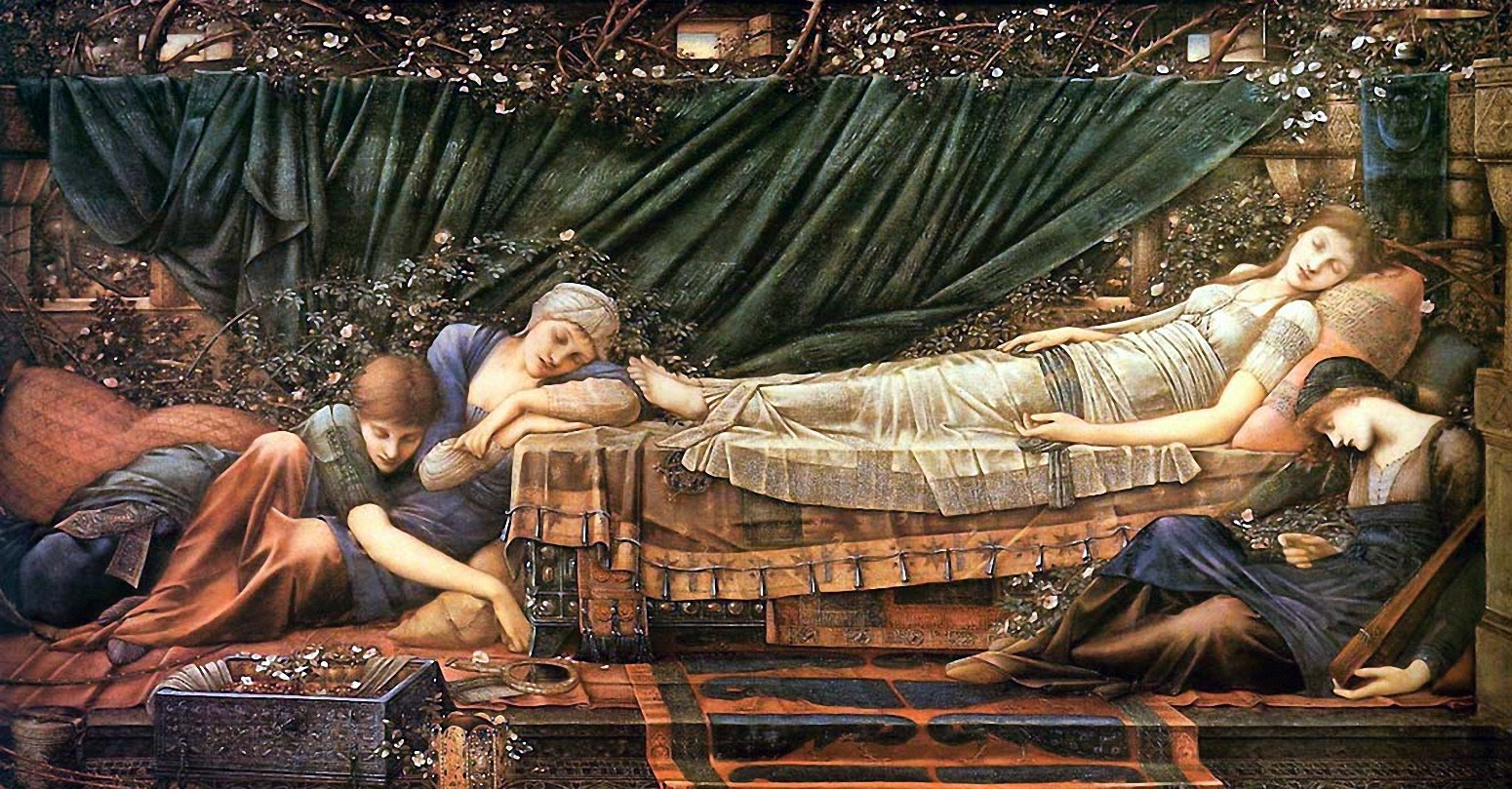
Lately, I've been thinking about how one branch of the arts can feed another. Famous examples abound. Mendelssohn wrote incidental music for "A Midsummer Night's Dream," which includes a theme that, for me, is the very embodiment of fairies and their flitty, flighty movements. Pre-Raphaelite painter Sir Edward Burne-Jones created the Briar Rose Series of paintings based on the story of the Sleeping Beauty, first published in 1697 by Charles Perrault.  


And how, you might wonder, does this pertain to my writing? Quite simply. My writing is better, stronger if I listen to music while I'm writing. Music can provide a focus. It can stir the emotions. Music is a driving force in my creative process.

That said, I thought I might share a couple of songs from my playlist for the recently completed novel.

http://www.youtube.com/watch?v=bOZsckDTjhg&feature=related


I listened to Garbage quite a bit when writing one character in particular. Chloe, the crazy goth chick, has one foot in reality and the other...well, no one really knows where she goes when she steps out. And this Seether song got heavy play during the chapter in which our hero is involved in some nefarious activity.


http://www.youtube.com/watch?v=S7br3d2eV8Q


Okay. You are a bright group, so I'm sure that by now, you've probably caught on that I really don't have much to say at this time about the writing process or the agent quest. So here's the skinny: I just sent a query letter to an agency today, so the waiting has begun again. I've gotten a lead on an anthology that may be the perfect place for my vampire short story and will be reworking it slightly to emphasize the theme of the anthology. And I'm writing a short story for another anthology in a round-robin with couple of friends.

That's my writing life at this moment.

Thursday, March 24, 2011

On Rejection

As you have probably guessed from the title of this entry, I've heard from the agency. They don't love me. In fact, two agents at two different agencies don't love me. And a magazine doesn't love my short story, either. So all in all, kind of a "You're a loser!" week on the writing front.

But that's okay. Rejection is part of the game. Like they always say, "If you're not getting rejections, you are not submitting." That's true for people who are just starting out. It's true for authors of most calibers. I'm just guessing here, but I'm fairly certain that there are only a few working authors who don't get rejection slips any more, and I'm fairly certain most of them have boxes full of them from early in their careers. Every now and then, a fluke will happen and the stars will all align and a brilliant new sun will blaze in the sky without a single rejection notice, but those moments are rare.

Here's a run-down of the events of the past two weeks:

The agency I really wanted to have represent me--the agency I emailed my query letter to back in December--held a contest, one that they compared to a "speed-dating" event. Hopeful authors had a one-hour window to submit their names, after which entries were closed. From the entrants, one hundred twenty-five names were drawn at random. Those people were invited to submit three pages of their finished novel. I was one of the fortunate few. (I feel like I should insert a smiley face icon here!)

A couple of days later, the field was narrowed to twenty-five, and those people were asked to submit ten pages. Again, I was in the running. (Would another smiling icon be too much?) The following week, the field was narrowed once more, this time to the top fifteen. Again, I was invited to submit, this time the first three chapters. When the next announcement was made, the agency would ask three contestants to submit their completed manuscripts.

This is where the dream ended for me. I got the email that told me that I was not among the three finalists. The gracious note basically said, "You did well, but we're not interested in your project at this time. Feel free to submit something else." So there it was, in black-and-white. They've looked at my book and don't want to see it again.

Not wanting to let any grass grow under my feet, I submitted a query letter to my second-choice agent that same day. Four days later, I had my rejection email from her.

The magazine I submitted to? They have an automatic notification to let you know when they've opened your submission. The rejection notice was time-stamped one minute later.

That's my fortnight in review. Rejection, rejection, rejection. And you know what? With all those rejections, I feel more like a writer!

Saturday, March 12, 2011

Why An Agent?

In this time of tremendous changes in the publishing industry, many people might wonder, "Do I really need an agent?"

My answer is, "Yes." Just like I would never dream of buying or selling a house without a real estate agent, I would never dream of selling a manuscript without a literary agent. There are so many aspects in the world of publishing that are complete mysteries to me. Agents know and understand contract law. They are familiar with publishing houses and with the editors at those houses, allowing them to submit directly to the right person at the right publisher. Any book can generate offers in other fields: foreign sales, ebook editions, audiobook editions, and occasionally, movie rights. Negotiations. Complications. Disagreements. Difficulties. My head starts to spin when I think of all the things that could go wrong. My solution for dealing with them: Magic Fairy Dust.

But with the world shortage of Magic Fairy Dust, I am left to more mundane solutions, and the solution I like best is having an agent. A good agent is a guide through the mean, labyrinthine backstreets of the publishing world. His or her job is to make my job easier. And if you're really lucky, your agent can also be your friend.  


Here's a video in which Lucienne Diver from the Knight Agency explains what literary agents do and how to find a good, reputable agent. She covers most of the issues I had thought of, then adds a few that had escaped me.

And so, the Great Agent Search continues. More about the progress on that front next week. Until then, keep reading! And keep writing!